Data Analyst to Engineer Salary: 2026 Transition Guide

The transition data analyst to engineer salary gap is real and substantial. Entry-level data engineers average around $95K while entry-level data analysts average $63K, a roughly $32K difference at the starting line alone. That gap widens significantly as careers progress. Making the switch is achievable, but it requires targeted technical skill development, a realistic view of temporary seniority resets, and a clear understanding of what the market actually pays. This guide gives you the salary benchmarks, skill roadmap, and career strategy you need to make the move with confidence.
What salary differences can you expect when transitioning to data engineering?
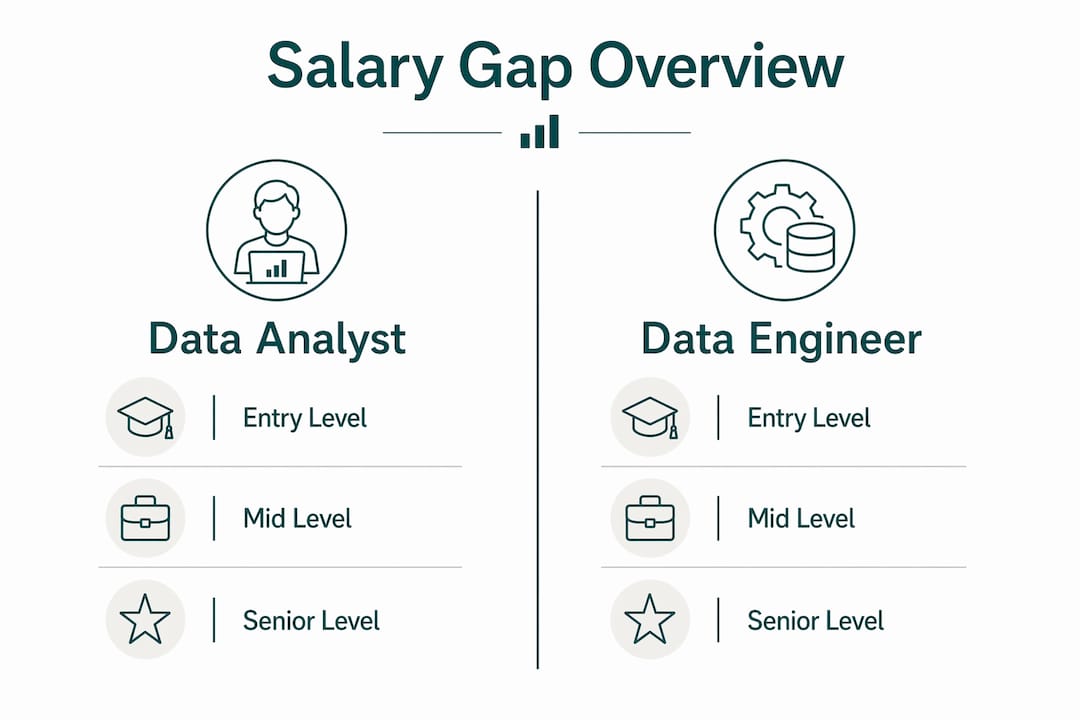
The data analyst to engineer salary gap is one of the most compelling reasons to make this career shift. The numbers favor engineers at every career stage, and the premium grows as you advance.
At the entry level, data engineers earn between $80K and $105K while data analysts in comparable roles typically earn $63K–$75K. That is a meaningful difference from day one. Mid-level data engineers command $119K–$155K, a range that most mid-level analysts simply cannot reach without moving into management or a specialized analytics engineering track.

The senior level is where the data engineer salary comparison becomes dramatic. Senior data engineers in tech metros clear $150K base, sometimes above $170K with equity. At top-tier tech companies, total compensation for senior data engineers ranges from $224K to $439K including equity and bonuses. That ceiling simply does not exist for most analyst roles.
| Career Stage | Data Analyst Range | Data Engineer Range | Salary Gap |
|---|---|---|---|
| Entry level | $63K–$75K | $80K–$105K | ~$32K |
| Mid level | $85K–$110K | $119K–$155K | ~$35K–$45K |
| Senior level | $110K–$140K | $150K–$190K+ | ~$40K–$50K+ |
| Staff / principal | $130K–$160K | $200K+ | $70K+ |
One important nuance: title inflation distorts these numbers. Misclassified analytics engineering roles earn $30K less than market value because companies label engineering work with analyst titles. If you are already doing dbt modeling, Snowflake tuning, or pipeline work under an analyst title, you are likely undercompensated right now. That makes the case for a formal title change even stronger.
Pro Tip: Check your current job description against data engineer postings before your next review cycle. If your responsibilities match, you have a documented case for a title upgrade or a salary adjustment.
What skills do you need to close the gap?
The data analyst engineer transition is not about starting over. SQL proficiency and domain knowledge already provide a strong foundation, and those skills transfer directly. The gap lies in specific technical competencies that define data engineering work.
The critical skills you need to develop include:
- Python programming beyond basic scripting. Data engineers write production-grade code, build reusable modules, and handle error logging. Pandas fluency is a start, but you need comfort with object-oriented patterns and testing frameworks.
- Cloud platforms. AWS, Google Cloud Platform, and Azure each have core data services you must know. S3, Glue, BigQuery, and Azure Data Factory are common starting points. Employers expect hands-on experience, not just conceptual familiarity.
- Orchestration tools. Apache Airflow is the industry standard for pipeline scheduling and monitoring. Knowing how to build, debug, and maintain DAGs is a baseline requirement for most data engineering roles.
- Distributed systems. Apache Spark is the highest-ROI skill for compensation. Demand for data engineers with Spark skills commands a $40K+ premium, making it a priority target for anyone serious about salary growth.
- Modern stack tools. dbt, Databricks, and AI infrastructure skills command 15%–40% salary premiums over traditional ETL roles. The market is splitting, and specialists in these tools earn significantly more.
Portfolio projects are not optional. Preparation typically involves 15–20 hours per week of focused study and project work. Build a public GitHub portfolio that includes an end-to-end pipeline, a cloud deployment, and an Airflow-orchestrated workflow. Hiring managers use these projects to evaluate engineering judgment, not just syntax knowledge.
The impact on starting seniority is real. Even strong analysts typically enter data engineering at a junior or mid-junior level. That is a deliberate trade-off, not a setback. You are buying into a higher salary ceiling in exchange for a short-term step back.
How long does the transition take, and what does salary progression look like?
Realistic transition timelines fall into two categories. An aggressive approach, dedicating 20+ hours per week to structured learning and project work, can produce job-ready skills in 3–4 months. A realistic pace for working professionals runs 6–12 months. Focused upskilling requires 15–20 hours per week for 6–12 months, emphasizing Python, cloud infrastructure, orchestration tools, and portfolio projects.
The salary progression after transition follows a clear arc:
- Year 0 (entry into engineering). Expect $80K–$95K if you enter at a junior level. This is the temporary step back most analysts experience.
- Year 1. With demonstrated delivery and growing cloud fluency, you move toward the $100K–$120K range. Performance reviews in engineering roles reward output directly.
- Year 2. Mid-level data engineering compensation of $119K–$155K becomes realistic. Salary growth trajectory for data engineers moves from entry at $85K–$110K to senior at $150K–$190K, with staff levels above $200K.
- Senior stage (3–5 years). Base salary above $150K is standard in most U.S. markets, with total compensation well above that in tech hubs.
Pro Tip: Track your salary recovery timeline before you make the move. If you earn $95K as a mid-level analyst and accept an $85K engineering role, calculate the break-even point. At a $40K annual premium post-recovery, you recoup the difference within 12–18 months.
The opportunity cost is manageable for most mid-level analysts. The transition is financially optimal at mid-level ($75K–$95K) rather than at senior analyst levels, where the salary step-back feels more painful and takes longer to recover. Senior analysts earning $130K+ face a harder short-term trade-off, though the long-term ceiling still justifies the move for many.
Common pitfalls include spreading learning too thin across too many tools, skipping portfolio projects in favor of certifications alone, and underestimating the time needed to build production-grade coding habits. Focus beats breadth at every stage of this transition.
What should you evaluate before making the switch?
The data analyst to engineer career path is not the right move for everyone at every moment. A structured self-assessment prevents costly mistakes.
The most financially rational time to transition is when you are a mid-level analyst earning $75K–$95K. At that salary, the short-term step back to a junior engineering role is small, and the long-term premium is large. Waiting until you reach senior analyst compensation increases the pain of the reset without meaningfully improving your engineering starting salary.
Consider these factors before committing:
- Current seniority and salary. Mid-level analysts gain the most from transitioning now. Senior analysts should model the break-even timeline carefully before deciding.
- Engineering vs. analytics management track. If your goal is people leadership, the analytics management path may offer comparable compensation without the technical retooling. Engineering is the right choice if you want to build systems and maximize individual contributor pay.
- Market demand for your target skills. Spark, dbt, Databricks, and AI infrastructure are the highest-demand specializations in 2026. Targeting these skills from the start positions you for the upper end of the salary range.
- Geographic and remote factors. Remote data engineer salary benchmarks vary significantly by market. San Francisco and New York command the highest base salaries, but remote roles increasingly pay competitive rates regardless of location.
- Salary negotiation readiness. Enter every offer negotiation with current market data. The data engineering pay premium over analytics roles is well-documented, and employers expect candidates to know their market value.
The analytics engineering category adds one more layer of complexity. Roles with titles like “analytics engineer” or “data platform analyst” often involve genuine engineering work but pay $30K below market because of title inconsistency. If you are targeting these roles, negotiate based on the engineering salary band, not the analyst band.
Key Takeaways
Transitioning from data analyst to data engineer delivers a $32K–$50K+ salary premium at every career stage, but requires 6–12 months of focused skill development and a temporary seniority reset.
| Point | Details |
|---|---|
| Salary gap is significant | Data engineers earn $32K–$50K more than analysts at comparable career stages. |
| Mid-level is the optimal entry point | Analysts earning $75K–$95K face the smallest step-back and fastest salary recovery. |
| Spark and modern stack skills pay most | Apache Spark commands a $40K+ premium; dbt and Databricks add 15%–40% above ETL roles. |
| Portfolio projects are non-negotiable | Hiring managers evaluate engineering judgment through real projects, not certifications alone. |
| Senior engineering ceiling is high | Staff-level data engineers earn $200K+ base, with total compensation above $400K at top firms. |
Why I think most analysts wait too long to make this move
The analysts I see struggle most with this transition are the ones who wait until they are senior. By then, the salary step-back feels like a punishment rather than an investment. They have spent years optimizing dashboards and building SQL queries, and the idea of earning $85K again after hitting $130K is genuinely hard to accept.
But the math does not lie. A mid-level analyst at $85K who steps into a junior engineering role at $80K for 18 months, then climbs to $130K by year two and $160K by year three, comes out far ahead of the analyst who waited. The compounding effect of the engineering salary ceiling is the point most people miss.
The other mistake I see constantly is chasing breadth over depth. Analysts sign up for every cloud certification available, learn the basics of five orchestration tools, and end up mediocre at all of them. Hiring managers notice. Pick Python, one cloud platform, Airflow, and Spark. Build two or three real projects that demonstrate end-to-end pipeline thinking. That portfolio beats a wall of certifications every time.
Salary negotiation is the final piece most analysts underestimate. Walking into an engineering offer without current market data is leaving money on the table. The data analyst salary benchmarks for your current role and the engineering ranges for your target role are both publicly available. Use them.
— Obinna
Benchmark your salary before and after the transition
Knowing the market rate for your current role and your target role is the single most powerful negotiation tool you have. Fairpayguide provides salary lookup and comparison data across roles, experience levels, and geographies so you can walk into every conversation with real numbers.
Use the Fairpayguide salary lookup to check current data engineer and data analyst compensation bands in your target market. Then submit your salary anonymously to help other analysts and engineers benchmark accurately. Every submission improves the data for the entire community. Salary transparency benefits everyone making this transition, and your contribution takes less than two minutes.
FAQ
What is the average salary increase from data analyst to data engineer?
The average salary increase is roughly $32K–$45K at comparable career stages. Entry-level data engineers earn around $95K versus $63K for analysts, and the gap widens at mid and senior levels.
How long does it take to transition from data analyst to data engineer?
Most working professionals complete the transition in 6–12 months with 15–20 hours of weekly study and project work. An aggressive full-time approach can compress this to 3–4 months.
Do you have to take a pay cut to become a data engineer?
A temporary pay cut is common, especially for mid-level and senior analysts entering engineering at a junior level. Most analysts recover and exceed their previous salary within 12–24 months.
What skills matter most for salary growth in data engineering?
Apache Spark, dbt, Databricks, and cloud platform expertise (AWS, GCP, Azure) command the highest premiums. Spark alone adds a $40K+ salary premium compared to traditional ETL skill sets.
Is the transition worth it financially for senior data analysts?
Senior analysts face the largest short-term salary step-back, but the long-term ceiling in data engineering still justifies the move for most. Modeling the break-even timeline before accepting an offer is the key step.