How to Track Salary Growth Over Time in 2026

Tracking salary growth over time is the process of systematically monitoring your income changes and progression throughout your career to evaluate and optimize your compensation trajectory. Most professionals review their pay only at annual review time, which means they miss the compounding effects of small raises, inflation erosion, and the premium that job switching delivers. Salary progression analysis requires more than glancing at your paycheck. It demands structured tools, clear metrics, and a habit of benchmarking your pay against real market data. This guide covers exactly what to measure, which tools to use, and how to build a personal system that keeps your career earnings on track.
How to track salary growth over time: key metrics that matter
Salary growth tracking is not just about recording your annual raise. It requires monitoring a set of interconnected metrics that together reveal whether your compensation is truly advancing or quietly falling behind.
Merit increases are the starting point. U.S. organizations planned a median base salary merit increase of 3.4%–3.5% for 2026, down from the elevated rates seen in 2022–2023. That figure represents the baseline expectation for most salaried employees, and anything below it warrants a conversation with your manager.

Job-switching premium is the metric most professionals underuse. Employees who change jobs in 2026 typically receive 12%–18% wage increases, compared to just 3%–4% for those who stay. That gap compounds dramatically over a decade. Knowing this number gives you concrete negotiating leverage and a clear signal for when staying is costing you money.
Beyond base pay, the key pay metrics to track include:
- Compa-ratio: Your salary divided by the midpoint of your pay band. A ratio below 1.0 means you are paid below market. A ratio above 1.0 means you are above midpoint.
- Position in salary band: Where you sit within the range for your role. Employees near the top of their band often receive smaller merit increases because the ceiling limits growth.
- Equity vesting schedules: Stock or RSU grants vest over time and represent real compensation. Ignoring them understates your total package.
- Promotional increases: These typically range from 8%–15% and represent the fastest path to salary acceleration within a single employer.
- Tenure effects: Salary growth tends to slow after three to five years in the same role, making tenure a useful signal for when to seek a promotion or move on.
Pro Tip: Calculate your compa-ratio every six months. Divide your current base salary by the midpoint salary for your role in your market. If the result is below 0.90, you have a documented case for a market adjustment.
What tools help you monitor salary increases and forecast growth?
The right salary growth tools turn raw pay data into a clear picture of your career trajectory. Several calculators and data sources serve distinct purposes, and using them together gives you the most complete view.
-
Salary increase calculators with inflation and tax adjustments. Tools like the CalcBold Salary Raise Calculator compute your net raise after federal and state taxes, then adjust for inflation to show your real raise. A 4% nominal raise in a year with 3.5% inflation delivers far less purchasing power than it appears.
-
Inflation-adjusted salary calculators. The Truflation Salary Calculator illustrates this clearly. A $50,000 salary from 2020 would need to reach approximately $64,000 in 2026 just to maintain the same purchasing power, reflecting roughly 28% cumulative inflation. If your salary has not kept pace, you have taken a real pay cut regardless of what your nominal raise percentage says.
-
Wage growth trackers. The Atlanta Fed Wage Growth Tracker and Bureau of Labor Statistics (BLS) Employment Cost Index provide population-level wage growth data. These benchmarks tell you whether your personal raises are outpacing, matching, or lagging the broader labor market.
-
CAGR calculators for career earnings. Compound Annual Growth Rate (CAGR) is the most precise way to measure long-term salary progression. Calculating CAGR for salary growth excludes income gap years so the result reflects your true career trajectory rather than distorted year-over-year averages.
-
Salary comparison and lookup tools. Platforms like Fairpayguide let you compare salary ranges for your specific role and location, giving you a real-time market benchmark to evaluate your current pay.
| Tool | Primary Use | Key Feature |
|---|---|---|
| CalcBold Salary Raise Calculator | Net and real raise calculation | Tax and inflation adjustment |
| Truflation Salary Calculator | Inflation-adjusted salary check | Cumulative inflation comparison |
| Atlanta Fed Wage Growth Tracker | Market wage growth benchmarking | Population-level wage data |
| BLS Employment Cost Index | Industry wage trend analysis | Quarterly wage growth data |
| CAGR Calculator | Long-term career growth rate | Excludes income gap years |
| Fairpayguide Salary Lookup | Role-specific market benchmarking | Real-time salary ranges |
Pro Tip: Run your salary history through a CAGR calculator every two years. A career CAGR of 5%–7% in real terms is strong. Anything below 3% after inflation suggests your compensation strategy needs a reset.
How do you build a personal salary tracking system?
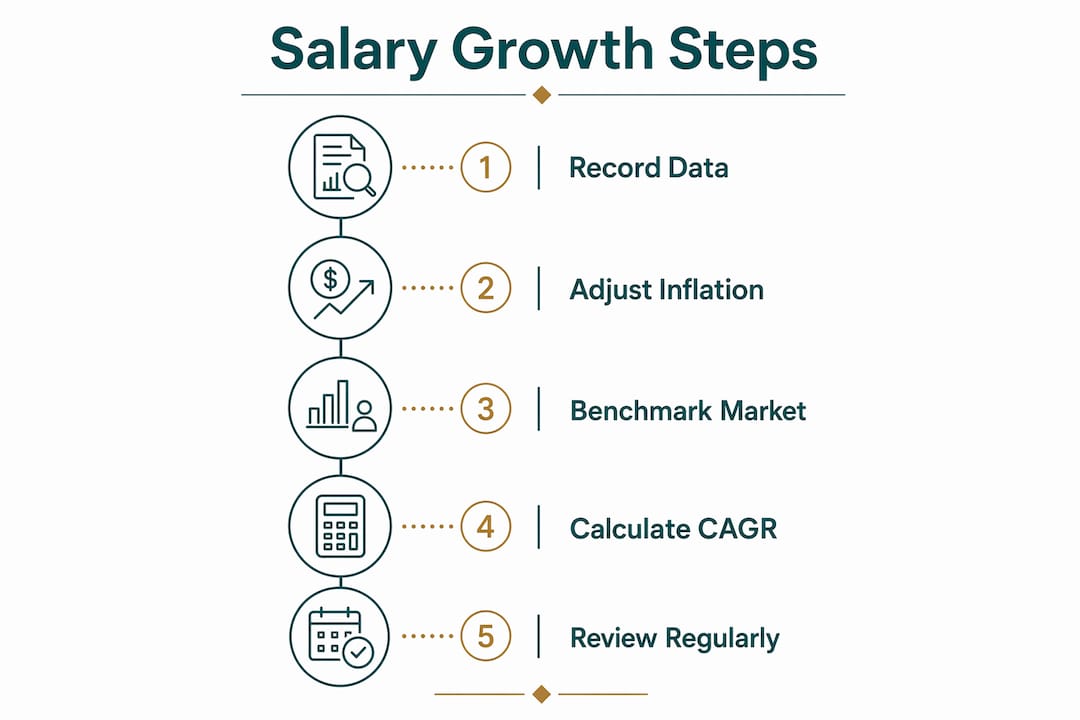
A personal salary tracking system turns scattered pay data into a clear record you can use at every negotiation. Here is a practical process to set one up and maintain it.
-
Record every compensation component. Log your base salary, annual bonus, signing bonus, equity grants and their vesting dates, and any other variable pay. Base salary alone understates your total compensation by 15%–30% for most mid-career professionals.
-
Document the timing and size of every increase. Note the date, the percentage increase, and the reason (merit, promotion, market adjustment). This history becomes your negotiation evidence and your growth trend line.
-
Adjust for inflation annually. Use the BLS CPI data or the Truflation Salary Calculator to convert each year’s salary into constant dollars. This reveals whether your real income is growing or shrinking despite nominal raises.
-
Calculate your after-tax income for each year. Tracking salary growth without adjusting for taxes and inflation can obscure your real raise and hide potential multi-million dollar lifetime earnings gaps. A spreadsheet with columns for gross salary, estimated taxes, and inflation-adjusted net pay gives you the clearest picture.
-
Benchmark against market data every 12 months. Use Fairpayguide’s salary lookup tool to compare your current pay against market ranges for your role, industry, and location. If you are below the 50th percentile for your experience level, you have a data-backed case for a raise.
-
Set a review trigger for job switching. If your salary CAGR over the past three years falls below 4% in nominal terms and you are already at or above your band midpoint, the data suggests that switching employers is the faster path to growth.
Your tracking system does not need to be complex. A Google Sheets or Excel spreadsheet with six columns (date, base salary, total compensation, inflation-adjusted salary, compa-ratio, and market percentile) covers everything you need.
What are the biggest mistakes when tracking salary changes?
Salary progression analysis fails when professionals make avoidable errors in how they measure and interpret their pay data. These are the most common and costly mistakes.
- Ignoring inflation. A 3% raise in a 4% inflation year is a real pay cut. Nominal growth numbers look positive while purchasing power declines. Always convert raises to inflation-adjusted figures before drawing conclusions.
- Tracking only base salary. Bonuses, equity, and benefits can represent 20%–40% of total compensation for many roles. Excluding them produces an incomplete and often misleading picture of your actual earnings trajectory.
- Misreading compa-ratio signals. Compa-ratio analysis shows your position relative to market midpoints. Employees above 1.10 often receive smaller percentage increases, not because they are underperforming, but because the band limits further growth. Recognizing this signals when a promotion or role change is the only path to meaningful salary acceleration.
- Underestimating compounding. A 1% difference in annual raise rate compounds into a significant earnings gap over 20 years. Most workers underestimate their lifetime salary growth impact by 3–5 times when they ignore inflation adjustment and long-term compounding.
- Skipping market benchmarking. Tracking your own salary history in isolation tells you how you have grown but not whether you are growing fast enough relative to the market. Without external benchmarks, you cannot know if you are ahead, at par, or falling behind peers in similar roles.
- Overlooking tax effects. A 5% raise in a higher tax bracket may deliver less net income than a 4% raise with a pre-tax benefit increase. Net and real raise calculations, not gross percentages, are what actually affect your financial position.
The most expensive career mistake is accepting a nominal raise as a real one. Run the inflation and tax math every single year. The gap between what you think you earned and what you actually earned in real terms is where lifetime wealth is lost.
Key takeaways
Consistent salary growth tracking, combining inflation adjustment, market benchmarking, and CAGR analysis, is the most reliable method for maximizing lifetime career earnings.
| Point | Details |
|---|---|
| Track total compensation | Include base pay, bonuses, and equity to avoid understating your true earnings growth. |
| Adjust for inflation annually | A $50,000 salary from 2020 requires roughly $64,000 in 2026 just to maintain purchasing power. |
| Use CAGR for long-term analysis | CAGR excludes income gap years and gives a precise measure of your career salary trajectory. |
| Benchmark against market data | Compare your pay to market ranges using tools like Fairpayguide to identify negotiation opportunities. |
| Know the job-switch premium | Switching jobs typically delivers 12%–18% increases versus 3%–4% for staying, a gap that compounds over time. |
Why i think most professionals track salary the wrong way
After years of working with compensation data and watching how professionals approach their own pay, one pattern stands out clearly. Most people treat salary tracking as a backward-looking exercise. They check what they made last year, compare it to this year, and feel satisfied if the number went up. That is not salary progression analysis. That is just reading a receipt.
The professionals who consistently outperform their peers in lifetime earnings do something different. They treat salary data the way an investor treats a portfolio. They track real returns after inflation, measure growth rates over multi-year periods, and compare performance against external benchmarks rather than just their own history. The IT career roadmap approach, where you map salary milestones to specific career stages, is far more useful than annual raise percentages alone.
The other thing I have observed is that people dramatically underestimate the value of a single percentage point. A professional who negotiates 5% annual raises instead of 3% over a 25-year career does not end up 50% wealthier. The compounding effect pushes that gap into the hundreds of thousands of dollars. That is not a rounding error. That is a retirement account.
My advice is direct. Build your tracking system now, run the inflation math every year, and use market data to negotiate rather than hoping your employer will volunteer a fair raise. Data does not negotiate for you, but it gives you the standing to negotiate for yourself.
— Obinna
Use Fairpayguide to benchmark your salary growth
Tracking your own salary history is only half the picture. The other half is knowing where you stand in the market right now.
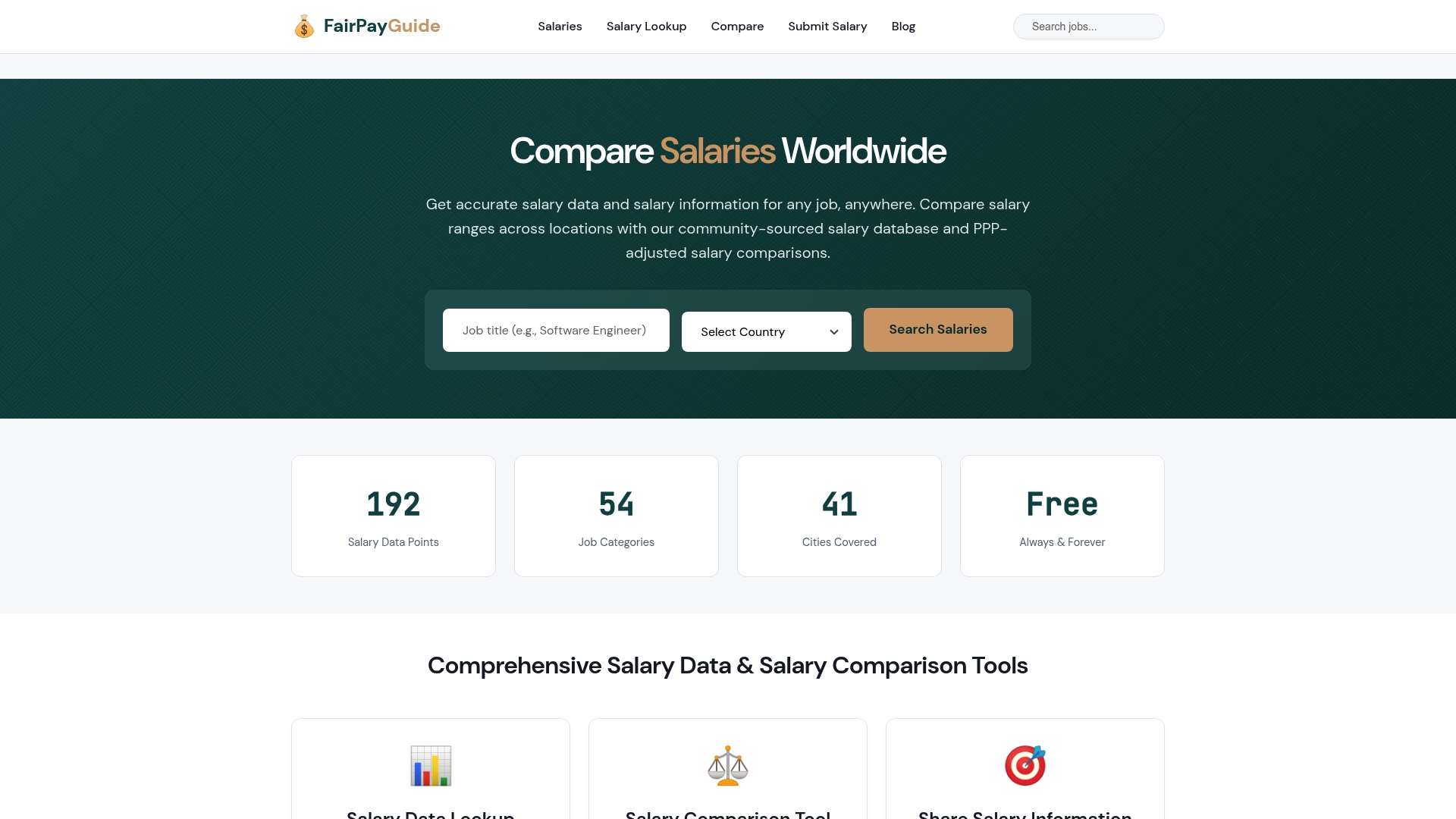
Fairpayguide provides real salary data for thousands of roles worldwide, so you can compare your current pay against what professionals in your field actually earn. You can look up salary ranges for your specific role and location in seconds. You can also submit your salary anonymously to contribute to the data pool that helps every professional benchmark more accurately. The more data professionals share, the more precise the benchmarks become for everyone. Use Fairpayguide alongside your personal tracking system to turn your salary history into a negotiation strategy backed by real market evidence.
FAQ
What does it mean to track salary growth over time?
Tracking salary growth over time means systematically recording your income changes, adjusting for inflation and taxes, and comparing your progression against market benchmarks to evaluate whether your compensation is advancing at a competitive rate.
How often should i review my salary progression?
Review your salary data at least once per year, ideally before your annual performance review. Run a market benchmark check every 12 months using a salary comparison tool to identify gaps between your pay and current market rates.
What is CAGR and why does it matter for salary tracking?
CAGR, or Compound Annual Growth Rate, measures your average annual salary growth over multiple years while excluding income gap periods. It gives a more accurate picture of your career trajectory than simple year-over-year comparisons.
How does inflation affect my real salary growth?
Inflation directly reduces the purchasing power of your salary. A $50,000 salary from 2020 requires approximately $64,000 in 2026 to maintain the same real value, meaning any raise below the inflation rate is effectively a pay cut.
Is it better to stay at my job or switch for higher pay?
The data favors switching in most cases. Job changers typically receive 12%–18% increases compared to 3%–4% for those who stay. If your salary CAGR has stalled and you are near the top of your pay band, switching is usually the faster path to meaningful income growth.