Job Market Salary Benchmarks 2026: What You Must Know

Job market salary benchmarks 2026 are defined as structured compensation reference points that tell you exactly where your pay stands relative to peers in your role, industry, and region. The median planned merit increase for U.S. organizations in 2026 sits at 3.5%, according to surveys from WorldatWork, Mercer, and Payscale. That number sounds straightforward. It is not. Understanding what sits behind it, and how to use it, is the difference between leaving money on the table and walking into your next negotiation fully prepared.
1. What are job market salary benchmarks 2026 and why do they matter?
Salary benchmarking is the practice of comparing your compensation against verified market data for equivalent roles. The industry term is compensation benchmarking, and it covers base pay, bonuses, equity, and benefits together. Generic salary averages tell you very little. A well-constructed benchmark tells you the 25th percentile, the median, and the 75th percentile for your exact role in your exact market.

The stakes are real. Applying uniform salary assumptions across regions and sectors risks mispricing both job offers and your own expectations. Finance analyst roles saw advertised salaries rise nearly 20% in early 2026, while software engineer and product manager roles declined over the same period. That kind of divergence makes a single national average useless for practical decisions.
2. What are the core components of 2026 salary benchmarks?
A complete salary benchmark covers more than your base pay number. Here are the key components you need to understand:
- Base salary: The fixed annual amount before bonuses or equity. Merit increases for 2026 average 3.1%–3.3%, with total increase budgets reaching 3.5% when promotional raises are included.
- Performance bonuses: Companies are shifting toward bonuses and promotional increases of 8%–12% rather than raising base salaries. This means your negotiation target should extend beyond base pay.
- Equity and signing bonuses: These are frequently undervalued. Equity, signing bonuses, and 401(k) contributions account for 30%–40% of total package value in competitive fields like tech and finance. Base salary is often only 60%–70% of what you actually earn.
- Benefits and retirement contributions: Health insurance, 401(k) matching, and paid time off carry real dollar values that belong in your total compensation model.
- Percentile distribution: The floor, ceiling, 25th percentile, and 75th percentile tell you far more than the median alone.
Pro Tip: Build a spreadsheet that captures all five components before any negotiation. If a recruiter quotes you a base salary, ask for the full compensation breakdown. A $90,000 base with strong equity and a 15% bonus target may outperform a $105,000 base with no additional upside.
Relying exclusively on median benchmarks is a common and costly mistake in 2026’s fragmented market. Distribution data gives you the full picture. It shows you whether you are underpaid relative to the top quartile or simply at market for your experience level.
3. Which industries and roles are seeing the most salary growth in 2026?
The 2026 salary outlook is not uniform. Growth rates vary sharply by sector and skill set, and knowing where the gains are concentrated changes your career strategy.
AI and Machine Learning roles are projected to grow at 4.4% in 2026, compared to just 1.6% for the overall technology sector. That gap reflects a structural shift, not a temporary spike. Companies are paying a premium for AI expertise because the supply of qualified professionals has not kept pace with demand.
The wage premium for AI skills is striking. Roles requiring AI expertise command an average 56% wage premium over comparable roles without those skills in early 2026. That figure nearly doubled from 25% just one year prior. Cybersecurity and cloud infrastructure roles show similar patterns, with wage growth rates 2–3x the national averages.
| Industry / Role | 2026 Salary Growth Rate | Notes |
|---|---|---|
| AI and Machine Learning | ~4.4% | Highest growth in tech sector |
| Financial services | ~3.7%–4.0% | Finance analyst roles up ~20% in advertised pay |
| Energy and pharma | ~3.7%–4.0% | Stable demand driving above-average increases |
| Overall technology | ~1.6% | Moderated from prior years |
| Software engineers | Declining (Q1 2026) | Oversupply in some markets |
| Cybersecurity | 2–3x national average | Persistent skills shortage |
Outside of tech, financial services, energy, and pharmaceuticals are posting growth in the 3.7%–4.0% range. These sectors benefit from stable demand and specialized skill requirements. For professionals in those fields, the 2026 job compensation picture is meaningfully better than the national average suggests.
4. How can you use salary benchmarks to negotiate better pay in 2026?
Negotiation without data is guesswork. Salary benchmarks give you the specific numbers to anchor your ask and defend it. Here is how to use them effectively:
- Lead with total compensation, not just base salary. If your base is at market but your bonus structure is weak, that is your negotiation target. Ask employers to detail their bonus history, not just the stated target percentage.
- Use percentile positioning. If you are performing at a senior level but paid at the 50th percentile, you have a documented case for a raise to the 75th percentile. Bring the data to the conversation.
- Leverage AI and cybersecurity skill premiums. If your role involves AI tools, data modeling, or security work, you qualify for the wage premium tier. Name it explicitly. Fairpayguide’s salary lookup tool lets you filter by skill set to confirm your premium positioning.
- Factor in the job-switching premium carefully. Changing employers typically yields a 10%–20% salary increase, but this premium has narrowed in 2026 due to a low-hire, low-fire labor market. The risk-reward calculation is different this year.
- Time your ask around promotional cycles. Since companies are focusing on bonuses and promotional increases rather than base hikes, requesting a title change alongside a compensation review often yields better results than a straight raise request.
Pro Tip: Before deciding to switch jobs for a pay bump, calculate the full value of your current package including unvested equity, 401(k) matching, and any pending bonuses. A 15% base salary increase at a new company can look smaller once you account for what you are leaving behind.
5. How do regional salary comparisons affect your benchmark research?
Regional salary comparisons in 2026 reveal gaps that national averages completely hide. A data scientist in San Francisco earns a materially different salary than the same role in Austin or Raleigh, even after adjusting for cost of living. Using a national median without a regional filter produces a benchmark that fits no one precisely.
The divergence is not limited to geography. Sector concentration matters too. Finance roles in New York and Chicago command premiums that reflect local market competition, not just cost of living. Energy roles in Houston follow a different curve than energy roles in Denver. The fragmented nature of 2026 salary trends means your benchmark research must be specific to your city and sector combination, not just your job title.
Remote work adds another layer of complexity. Some companies pay based on the employee’s location. Others pay a single national rate. Knowing which policy your employer or target employer uses changes how you interpret regional data. Always confirm the compensation philosophy before anchoring your negotiation to a geographic benchmark.
6. What are the best salary comparison tools for 2026?
Accurate salary benchmarks require reliable sources. The tools and guides below represent the most trusted references for 2026 job compensation data:
- Fairpayguide Salary Lookup: Fairpayguide’s salary comparison platform lets you search by role, location, and seniority level. The data reflects real-time market inputs and covers a wide range of industries.
- Robert Half Salary Guides: Robert Half publishes annual salary guides by function, including technology, finance, and marketing. The 2026 technology salary trends report from Robert Half is one of the most cited sources for role-specific tech compensation data.
- Mercer and WorldatWork surveys: These are the gold standard for HR professionals and are increasingly accessible to individual contributors. They provide percentile distributions, not just medians.
- Payscale: Payscale offers self-reported salary data with filters for experience, education, and location. It is most useful for cross-referencing against survey-based sources.
- JobsPikr Compensation Intelligence Reports: JobsPikr aggregates job posting data to track real-time shifts in advertised salaries, which often lead survey data by several months.
The key to using any of these tools well is triangulation. No single source captures the full picture. Pull data from at least two sources, compare the percentile distributions, and weight the results toward sources that match your specific industry and region. AI-driven recruitment platforms are also beginning to surface compensation benchmarks directly in job listings, as noted in recent analysis of AI in recruitment.
Key takeaways
Accurate salary benchmarking in 2026 requires industry-specific, regional, and total-compensation data rather than national median figures alone.
| Point | Details |
|---|---|
| Merit increases are modest | Plan around 3.1%–3.5% base increases; target bonuses and promotions for larger gains. |
| AI skills command a 56% premium | Professionals with AI expertise earn significantly above standard benchmarks in 2026. |
| Total comp exceeds base pay | Equity, bonuses, and benefits represent 30%–40% of package value in competitive fields. |
| Regional data is non-negotiable | National averages mask wide gaps; always filter benchmarks by city and sector. |
| Job-switching premium has narrowed | The 10%–20% gain from changing employers is real but smaller than in prior years. |
My take on salary benchmarking in 2026
The most common mistake I see professionals make is treating salary benchmarks as a single number. They find the median on a salary site, decide they are underpaid or fairly paid, and stop there. That approach was always incomplete. In 2026, it is genuinely dangerous.
The divergence between sectors has accelerated faster than most people expected. AI-related roles are not just growing faster. They are operating in a different compensation tier entirely. A 56% wage premium for AI expertise is not a rounding error. It is a structural shift that changes the calculus for anyone deciding whether to upskill, switch roles, or negotiate a raise.
What I find most underappreciated is the total compensation gap. Professionals in tech and finance routinely undervalue their equity and retirement contributions by tens of thousands of dollars. When you are comparing offers or preparing a negotiation, that gap is where the real money lives. The base salary number is the headline. The full package is the story.
I also want to push back on the conventional wisdom that job-switching is always the fastest path to higher pay. The premium is real, but it has compressed. And in a low-hire, low-fire market, the risk of landing in a role that underdelivers is higher than it was two years ago. Staying put and negotiating aggressively with solid benchmark data, especially if you have AI or cybersecurity skills, can produce comparable results with far less disruption. You can explore more on this through Fairpayguide’s salary insights blog for deeper analysis on compensation strategy.
The professionals who will win in 2026 are the ones who treat compensation as a model, not a number.
— Obinna
How Fairpayguide helps you benchmark your 2026 salary
Fairpayguide is built for exactly this kind of research. Whether you are preparing for a negotiation, evaluating a new offer, or simply checking where you stand in your market, the tools on Fairpayguide give you the specificity you need.
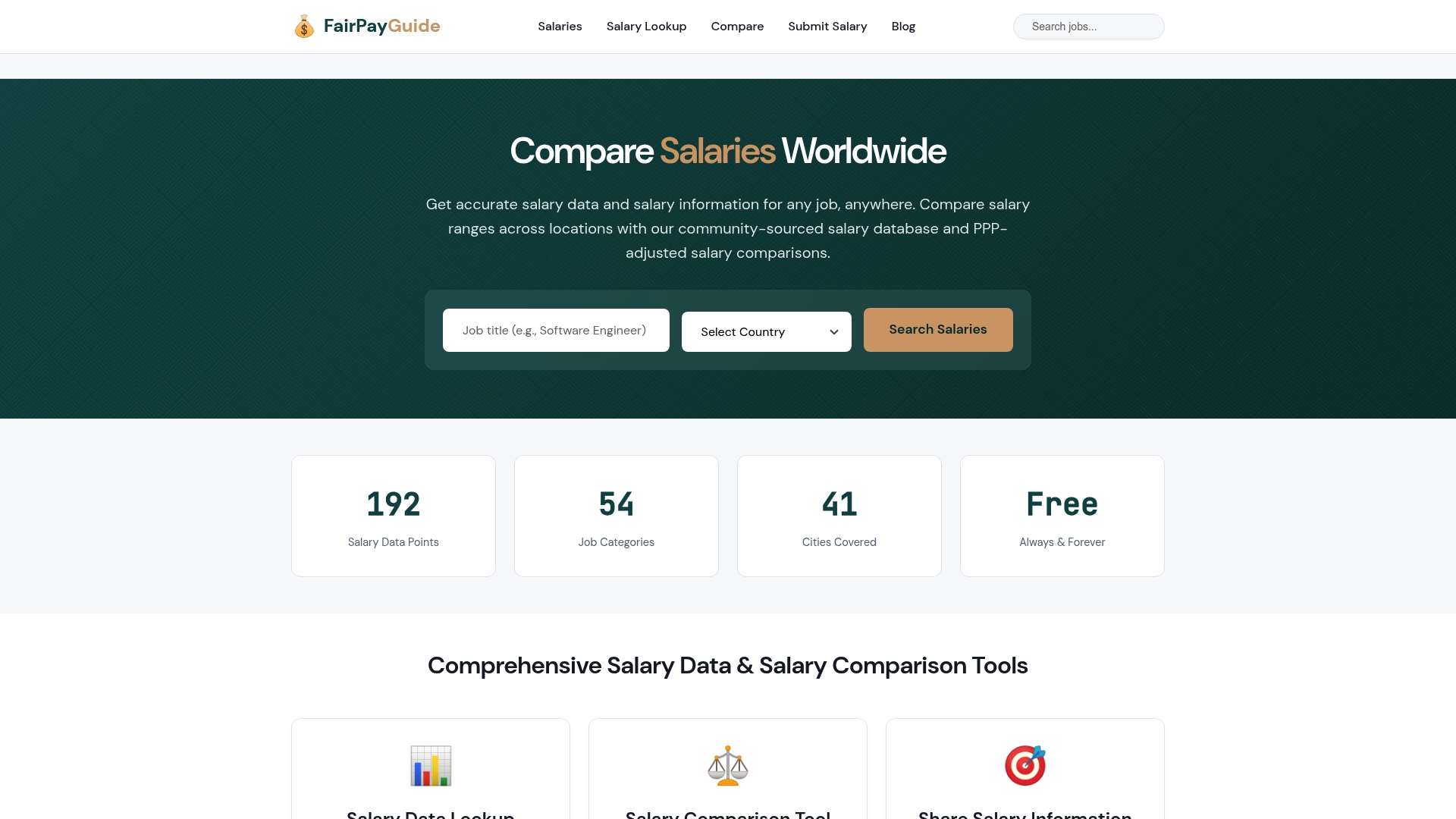
Use the Salary Lookup tool to search by role, location, and experience level and get a full percentile breakdown rather than a single average. You can also submit your salary anonymously to contribute to the dataset and help improve the accuracy of benchmarks for everyone in your field. Fairpayguide’s data covers industries from technology and finance to healthcare and logistics, updated to reflect the real shifts happening in the 2026 job market. Your next negotiation starts with knowing your number.
FAQ
What is a salary benchmark?
A salary benchmark is a compensation reference point that shows how a specific role’s pay compares to the broader market, typically expressed as a range with percentile breakdowns. It covers base salary, bonuses, and total compensation rather than a single average figure.
What is the average salary increase for 2026?
The median planned merit increase for U.S. organizations in 2026 is approximately 3.5%, with merit-only increases averaging 3.1%–3.3%, according to surveys from WorldatWork, Mercer, and Payscale. Companies are supplementing modest base increases with performance bonuses and promotional raises in the 8%–12% range.
Which roles have the highest salary growth in 2026?
AI and Machine Learning roles lead with projected salary growth of 4.4%, compared to 1.6% for the overall technology sector. Cybersecurity and cloud infrastructure roles also show growth rates 2–3x the national average due to persistent skills shortages.
Is it worth switching jobs for a higher salary in 2026?
Changing employers still typically yields a 10%–20% salary increase, but the premium has narrowed in 2026’s low-hire, low-fire labor market. Weigh the full value of your current package, including unvested equity and bonuses, before making the move.
How do I find accurate salary benchmarks for my specific role?
Use multiple sources and filter by role, location, and seniority level. Fairpayguide’s salary lookup, Robert Half’s annual guides, Mercer surveys, and Payscale all provide useful data. Cross-referencing at least two sources gives you a more reliable range than relying on any single platform.