What Is a Career Earnings Ceiling? Your 2026 Guide

A career earnings ceiling is defined as the maximum income a professional can realistically reach within a given role, industry, or career path. This limit is not always visible on a job posting or in a salary negotiation. It is shaped by organizational pay structures, market demand, and the long-term earning trajectory of your chosen field. Understanding your salary ceiling meaning early gives you the power to plan around it, not just accept it.
The gap between careers with high ceilings and those that plateau early is significant. Lifetime earnings differences between early-plateau and high-growth careers can exceed $800,000. That figure is not just a number. It represents the compounded effect of choosing a field with limited upward mobility versus one with sustained demand and rising compensation.
What is a career earnings ceiling, and what causes it?
A career earnings ceiling is the point at which your income stops growing in any meaningful way, regardless of your performance or tenure. The causes are structural, not personal. Recognizing them is the first step toward doing something about them.
The most common causes include:
- Salary bands and pay grades. Most companies use compensation frameworks that cap pay at each level. Most employees hit salary ceilings due to company salary bands rather than performance. High performance does not guarantee salary growth beyond those bands.
- Role and organizational hierarchy limits. If there are only two levels above you and both are filled, your upward path is blocked regardless of your skill set.
- Industry demand and market saturation. Fields with declining demand compress wages over time. Careers in healthcare and skilled trades show long-term demand durability and higher ceilings compared to declining industries.
- Regulatory and external factors. Some ceilings are set by law or policy. The Social Security earnings test in 2026 caps income at $24,480 for early retirees before benefits are reduced. That is a hard regulatory ceiling affecting millions of workers near retirement.
- Skills and education gaps. Without credentials or specialized knowledge that the market values, your earning range stays narrow.
Pro Tip: Do not confuse your company’s pay ceiling with the market ceiling for your role. They are often very different numbers. Checking salary data on platforms like Fairpayguide helps you see the difference clearly.
How do career income limits vary across industries?
Not all careers are created equal when it comes to maximum earning potential. The field you choose sets the outer boundary of your income, and that boundary varies dramatically.

| Profession | Entry-Level | Mid-Career | Ceiling |
|---|---|---|---|
| Registered Nurse | $55,000 | $80,000 | $110,000+ |
| Software Engineer | $85,000 | $130,000 | $200,000+ |
| Financial Advisor | $55,000 | $100,000 | $200,000+ |
| High School Teacher | $40,000 | $60,000 | $80,000 |
| Skilled Tradesperson | $45,000 | $70,000 | $95,000+ |
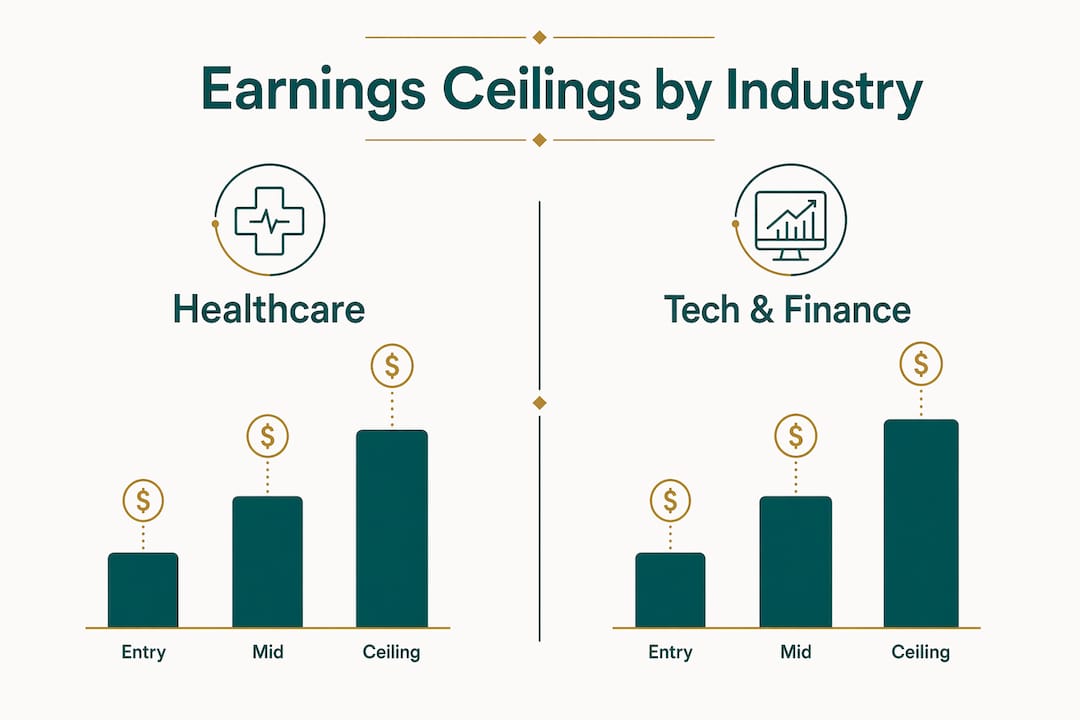
Late-career ceiling data shows registered nurses reaching $110,000+ while software engineers and financial advisors can exceed $200,000. The difference in lifetime earnings between these paths is substantial.
Geography compounds the gap further. A software engineer in New York faces a different ceiling than the same role in a smaller market. Location is one of the most underrated factors affecting career income. Professionals who are willing to relocate or work remotely for high-cost-of-living employers can push their ceiling significantly higher.
The slope of earnings growth matters as much as the starting salary. Market demand durability influences ultimate career ceilings more than entry pay alone. A field that pays well at 25 but plateaus at 35 delivers far less lifetime income than a field with steady growth into your 50s.
Pro Tip: When evaluating a career path, look at the ceiling, not just the starting salary. A field that pays $20,000 more at entry but plateaus $60,000 lower at peak is the worse financial choice over a 30-year career.
How can you tell if you’ve hit your earnings ceiling?
Median earnings peak in mid-career at ages 35–44, around $72,000. After that point, wage growth slows for most workers. If you are in that age range and your salary has been flat for two or more years, you may be approaching or sitting at your ceiling.
The clearest signs that you have hit a salary ceiling include:
- Your last three performance reviews were positive, but your raises were under 3%.
- You have been passed over for promotion more than once without a clear skills gap explanation.
- Colleagues hired externally at your level earn more than you do.
- Your manager cannot give you a clear path to the next compensation tier.
- You have maxed out your pay grade within the current company structure.
The most important distinction to make is between a company ceiling and a market ceiling. Many salary plateaus are company-specific and can be resolved by switching employers or building new skills. A market ceiling is broader and harder to move. Knowing which one you face changes your strategy entirely.
Salary comparison tools give you the clearest read on where you stand. Fairpayguide publishes salary ranges by role and location, so you can benchmark your current pay against real market data. If the market pays $30,000 more than your employer does for the same role, you are not at a market ceiling. You are at a company ceiling, and that is fixable.
What strategies can raise your career earnings ceiling?
Breaking through a salary ceiling requires deliberate action. Waiting for your employer to recognize your value rarely works. Here are the most effective strategies, ranked by impact:
-
Switch employers. Switching jobs is the fastest way to increase salary. Big pay jumps come with new roles at new companies, not incremental raises at your current employer. If you have been in the same role for three or more years, the external market likely values you higher than your current pay grade reflects.
-
Stack high-value skills. Specialization raises your market ceiling. A software engineer who adds machine learning expertise or cloud architecture credentials moves into a higher compensation tier. The IT career roadmap for 2026 shows how specific technical skills translate into measurable salary jumps.
-
Negotiate with market data. Salary negotiation without data is guesswork. Bring specific numbers from salary benchmarks to every compensation conversation. Employers respond to market evidence far more than to tenure or loyalty arguments.
-
Make lateral moves into higher-ceiling fields. A project manager in manufacturing and a project manager in biotech hold the same title but face very different ceilings. Moving laterally into a higher-paying industry resets your earnings trajectory without requiring a title change.
-
Deepen expertise and influence. Career growth can mean deepening expertise or influence, not only climbing titles. Becoming the recognized expert in a niche commands premium pay and consulting opportunities that bypass traditional pay bands entirely.
-
Consider self-employment or consulting. Business ownership removes the organizational ceiling entirely. The tradeoff is income variability, but the upside is uncapped. Many professionals use consulting as a bridge between salaried roles to test their market value.
Understanding the difference between progression and advancement is critical here. Progression means climbing the organizational chart. Advancement means deepening skill and influence. Internal ceilings often require external moves to reset earnings, because the organizational structure itself limits what you can be paid regardless of your contribution.
Key Takeaways
A career earnings ceiling is set by industry, role structure, and market demand, and professionals who recognize their ceiling early take control of their income trajectory faster.
| Point | Details |
|---|---|
| Ceilings are structural, not personal | Pay bands and hierarchy limits cap income regardless of your performance level. |
| Industry choice sets the outer limit | Software engineers and financial advisors can exceed $200,000; teachers often plateau near $80,000. |
| Company vs. market ceiling | Many plateaus are company-specific and resolved by switching employers or building new skills. |
| Job changes drive the biggest gains | Switching employers delivers larger salary increases than incremental internal raises. |
| Market data is your best tool | Benchmarking your pay against real salary data reveals whether you face a company or market ceiling. |
Why I think most professionals misread their own ceiling
Here is what I have seen repeatedly: professionals assume their salary plateau is a verdict on their worth, when it is almost always a verdict on their employer’s pay structure. The ceiling belongs to the company, not to you.
The most damaging career mistake I observe is conflating loyalty with income growth. Staying at one employer for a decade does not automatically raise your ceiling. In many cases, it lowers your effective market value because your salary history anchors every future negotiation. The professionals who grow their income fastest treat their career as a portfolio, not a marriage.
The other pattern worth naming is the confusion between a shrinking industry and a personal limitation. If your field is contracting, your ceiling is falling regardless of your performance. Prioritizing careers with demand durability over just high initial pay is one of the most underrated career decisions you can make. A field that pays well today but faces automation or offshoring in ten years is a ceiling that moves down, not up.
Proactive career management beats waiting for promotions every time. The professionals I respect most treat salary data the way investors treat market data: they check it regularly, act on it, and never assume the current price is the fair price.
— Obinna
Fairpayguide helps you see your real salary potential
Understanding your earnings ceiling starts with knowing what the market actually pays for your role, your skills, and your location. Fairpayguide brings that data together in one place.
Use the salary lookup tool to find real pay ranges for your role across cities and industries. If you want to contribute to the data that helps other professionals benchmark their pay, you can submit your salary anonymously in minutes. Every submission makes the market more transparent for everyone. The more accurate the data, the better every professional can assess whether they are at a company ceiling or a true market ceiling.
FAQ
What is a career earnings ceiling in simple terms?
A career earnings ceiling is the maximum income you can realistically reach in your current role or field. It is shaped by industry demand, company pay structures, and your level of specialization.
Why do most professionals hit a salary ceiling?
Most employees hit salary ceilings because of company pay bands, not poor performance. Internal compensation frameworks cap pay at each level regardless of individual output.
How do I know if I’ve hit my ceiling or just my company’s limit?
Compare your current salary to market data for your role and location. If the market pays significantly more than your employer does, you face a company ceiling, not a market ceiling.
What is the fastest way to increase earnings past a ceiling?
Switching employers is the fastest path to a significant salary increase. Big pay jumps come with new roles at new companies rather than incremental raises at your current employer.
Does the Social Security earnings test create a real income ceiling?
Yes. The Social Security earnings test in 2026 caps income at $24,480 for early retirees before benefits are reduced, creating a hard regulatory ceiling for workers who claim benefits before full retirement age.