Why Salaries Plateau in Careers: Key Causes

A salary plateau is defined as a period of stalled promotions and limited pay growth caused by structural, organizational, and individual career factors working together. Understanding why salaries plateau in careers is the first step to doing something about it. Approximately 24.2% of mid-career white-collar professionals experience a career stall lasting five or more years. That figure, drawn from a study of 1.3 million career histories by the Burning Glass Institute and NYU SPS, confirms that salary stagnation is not a personal failure. It is a systemic pattern shaped by skill misalignment, organizational structure, and visibility gaps that most professionals never see coming.
Why do salaries plateau in careers? what the data shows
The scale of career salary stagnation is larger than most people realize. The NYU SPS and Burning Glass Institute study analyzed 1.3 million career histories and found that stalled software developers lose over $43,000 in wages over 15 years compared to peers who kept advancing. That is not a rounding error. It is a career-defining financial gap that compounds over time.
The data also reveals how gradually a plateau develops. By year 10, stalled professionals average fewer promotions (1.5 versus 1.9) and significantly less wage growth (45% versus 66%) compared to peers who avoided stalls. The gap does not appear overnight. It builds slowly, which is exactly why so many professionals miss the early warning signs.

Education and credentials reduce stall risk, but they do not eliminate it. Early career momentum is one of the strongest predictors of long-term salary growth. Professionals who had fewer early promotions in their first decade were significantly more likely to plateau later. This means the patterns that lead to career salary stagnation often begin years before the plateau becomes visible.
Pro Tip: Track your promotion frequency and salary growth rate every two years. If either metric is slowing, treat it as an early signal, not a temporary dip.
| Industry | Stall Rate |
|---|---|
| Public Administration | 33.4% |
| Real Estate | 30.2% |
| Finance | 26.6% |
| Information Technology | Below average |
Industry matters significantly. Public Administration carries a 33.4% stall rate, Real Estate 30.2%, and Finance 26.6%. These sectors share rigid hierarchies and limited internal mobility, which are structural conditions that trap capable professionals regardless of performance.
What are the most common career salary plateau causes?
The causes of salary plateau fall into two broad categories: structural and individual. Most professionals focus on the individual side and miss the structural factors entirely.
Structural causes include:
- Limited promotion ladders. Many organizations have flat hierarchies with few senior roles. When those roles are filled, upward movement stops regardless of performance.
- Unclear career paths. 33% of businesses lack a defined vision for skills, and 48% have poor visibility into what their employees can actually do. Without that clarity, advancement decisions become arbitrary.
- Organizational culture gaps. Companies without formal recognition systems or leadership development programs produce plateaus by default. Talent stagnates when there is no mechanism to surface it.
Individual causes include:
- Skill ceiling. Your expertise stops commanding higher pay when the market has absorbed it or when your skills no longer align with where the organization is heading.
- Visibility ceiling. This is the most underestimated factor. Employees may have high expertise but remain invisible to the decision-makers who control promotions and raises. Competence without visibility does not advance careers.
- Misalignment plateau. This occurs when your skills and interests no longer match your role, creating disengagement that slows performance and advancement simultaneously.
Pro Tip: Ask yourself two questions: “Does my manager’s manager know what I contribute?” and “Are my skills aligned with where this company is heading?” If the answer to either is no, you have identified your plateau type.
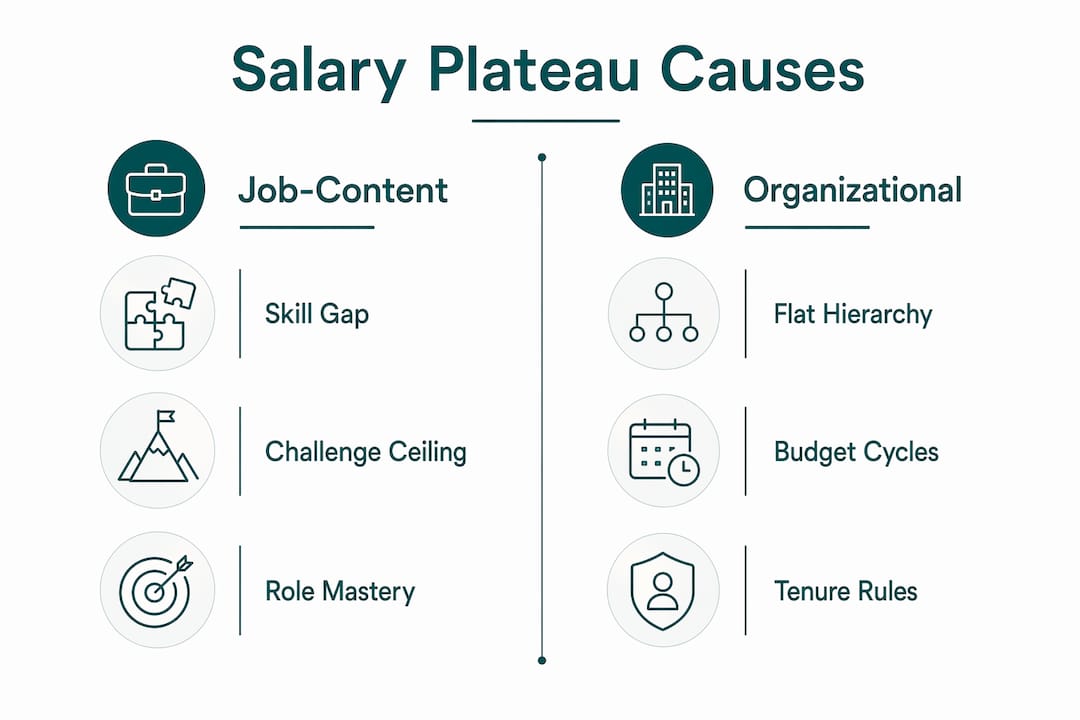
Distinguishing between a job-content plateau and an alignment plateau is critical to choosing the right response. A job-content plateau means the work itself has become routine and unchallenging. An alignment plateau means your skills and the organization’s needs have diverged. The interventions for each are completely different, and confusing them leads to the wrong career moves.
How does salary stagnation differ across industries and roles?
The way salary stagnation manifests depends heavily on your industry and job function. A software developer and a public administrator may both be plateaued, but for entirely different reasons.
Technology vs. public sector: a structural comparison
In IT, plateaus often take the form of job-content stagnation. A developer masters a stack, delivers reliably, and then stops growing because the role no longer challenges them. Research by Kwon (2022) links this skill-challenge imbalance to psychological distress and burnout, even among high performers. The problem is not lack of ability. It is lack of challenge. You can review what this looks like in practice through Fairpayguide’s IT career salary milestones for 2026.
In public administration, the plateau is more structural. Promotion timelines are tied to tenure and budget cycles, not performance. The 33.4% stall rate in that sector reflects a system where advancement is rationed, not earned. Finance and real estate follow similar patterns, with hierarchies that compress over time as organizations flatten.
| Plateau Type | Primary Driver | Most Affected Sectors |
|---|---|---|
| Job-Content Plateau | Skill-challenge imbalance | Technology, Engineering |
| Structural Plateau | Limited promotion ladders | Public Administration, Finance |
| Alignment Plateau | Skills diverge from org needs | Real Estate, Corporate Services |
| Visibility Plateau | Contributions unseen by leadership | All sectors |
Automation and AI are reshaping which roles face salary growth limits. Roles with highly routine task profiles are seeing pay compression as AI handles more of the workload. This is accelerating workforce skill gaps in ways that traditional career ladders were not built to handle. Professionals who do not adapt their skill sets are increasingly exposed to stagnation, regardless of their seniority.
Internal mobility is one of the most effective structural solutions available. Moving laterally into an adjacent role within the same company can reset career momentum without requiring a job change. The data on this is striking.
How can you break through a salary plateau?
Breaking through a salary plateau requires a clear diagnosis of which type you are facing, followed by targeted action. Generic advice like “work harder” or “ask for a raise” does not address the root cause.
Here are the most effective strategies, ranked by impact:
-
Reskill into an adjacent role. Targeted reskilling into adjacent roles can reduce stall risk by up to 86%. A programmer who transitions into data science, for example, resets their career trajectory without leaving their employer. This is the single highest-impact move available to most plateaued professionals.
-
Use internal mobility before external job searching. Lateral moves within your current organization preserve institutional knowledge and relationships while opening new growth paths. Many professionals overlook this option because it does not feel like advancement. It is.
-
Build visibility with decision-makers. Competence alone does not drive promotions. You need the people who control compensation decisions to understand your contributions. Present results in leadership meetings, volunteer for cross-functional projects, and make your impact measurable and visible.
-
Benchmark your salary against market data. Many professionals do not know whether their pay is below market until they look. Use tools like Fairpayguide’s salary lookup tool to research current pay ranges for your role, level, and location. This data gives you a factual basis for negotiation.
-
Earn credentials that signal market relevance. Certifications in high-demand areas, whether cloud architecture, data analysis, or project management, signal to employers that your skills are current. They also open doors to roles with higher pay ceilings.
-
Know when to switch employers. Internal options are not always available. If your organization has a flat hierarchy and no internal mobility program, external movement may be the only path to meaningful salary growth. Fairpayguide’s analysis of why professionals leave their jobs shows that stagnant wages are among the top drivers of voluntary turnover.
-
Monitor your career trajectory proactively. Do not wait five years to notice a stall. Use resources like Fairpayguide’s guide on tracking salary growth to identify slowdowns early, when you still have time to course-correct.
Key takeaways
Salary plateaus are systemic, not personal, and the professionals who break through them do so by diagnosing the specific cause and responding with targeted action rather than general effort.
| Point | Details |
|---|---|
| Plateaus are widespread | Nearly 1 in 4 mid-career professionals stall for five or more years, per Burning Glass Institute research. |
| Financial cost is real | Stalled software developers lose over $43,000 in wages over 15 years compared to advancing peers. |
| Two ceiling types exist | Skill ceilings and visibility ceilings require different interventions; misdiagnosing them leads to wrong moves. |
| Adjacent role shifts work | Reskilling into an adjacent role reduces stall risk by up to 86%, making internal mobility a top strategy. |
| Early signals matter | Slower promotion frequency and wage growth in years 1–10 predict later plateaus, so act before the stall sets in. |
What i’ve learned about salary plateaus after years in career data
The most important thing I have come to understand about salary stagnation is that it is almost never about performance. The professionals I see stuck in plateaus are often the most reliable people in their organizations. They deliver consistently, they do not cause problems, and they get passed over anyway. That is not a performance story. It is a visibility and structure story.
The research from NYU SPS and the Burning Glass Institute confirms what I have observed: mid-career stall is a systems problem, not an individual failure. But knowing that does not make it less urgent. You still have to act, because the system will not fix itself on your behalf.
The professionals who break through plateaus fastest are the ones who get specific. They do not just “network more” or “ask for feedback.” They identify whether their ceiling is structural, skill-based, or visibility-based, and they target that specific constraint. That precision is what separates people who escape stalls from people who wait and hope.
My honest advice: do not wait for your manager to notice. Use salary data, track your own trajectory, and make your case with numbers. The LinkedIn visibility gap is real for many IT professionals, and relying on a single platform or a single relationship to drive your advancement is a structural risk you can control.
— Obinna
See where your pay stands with Fairpayguide
If you suspect your salary has stalled, the first step is knowing where you actually stand relative to the market.
Fairpayguide gives you the data to answer that question directly. You can submit your salary anonymously to contribute to a growing database of real compensation figures, then use Fairpayguide’s salary comparison tool to see how your pay compares across roles, industries, and locations worldwide. Whether you are trying to build a case for a raise, evaluate a job offer, or simply understand whether your career is on track, Fairpayguide’s tools give you a factual foundation to work from. Salary transparency is the starting point for every career decision that actually moves you forward.
FAQ
What is a career salary plateau?
A career salary plateau is a period in which a professional receives no meaningful pay raises or promotions for an extended time, typically five or more years. Research from the Burning Glass Institute and NYU SPS shows this affects approximately 24.2% of mid-career white-collar workers.
Why do pay raises stop after mid-career?
Pay raises often stop because of structural limits like flat hierarchies, skill ceilings where expertise no longer commands premium pay, and visibility gaps where contributions go unrecognized by decision-makers. These factors frequently combine rather than operate in isolation.
Which industries have the highest salary stall rates?
Public Administration has the highest stall rate at 33.4%, followed by Real Estate at 30.2% and Finance at 26.6%. These sectors share rigid promotion structures and limited internal mobility compared to fields like IT.
How effective is reskilling for breaking a salary plateau?
Targeted reskilling into an adjacent role can reduce stall risk by up to 86%, according to the Burning Glass Institute study. Moving from a programmer role into data science is one documented example of this type of career reset.
How can i tell if my salary growth has stalled?
Compare your promotion frequency and wage growth rate over the past five years against industry benchmarks. If your wage growth is below 45% over a decade while peers average 66%, you are likely in a stall and should act before the gap widens further.