What Does Base Salary Mean? A Clear Guide for Job Seekers

Base salary is defined as the fixed amount of money an employer agrees to pay you for your work, before bonuses, commissions, or benefits are added. It is the guaranteed core of your paycheck, and it forms the foundation of your entire compensation package. Base salary makes up roughly 70% of a standard employee’s total compensation. That single number shapes your retirement savings, your tax bracket, and your negotiating power for years to come. Understanding what base salary means is the first step toward making smarter career and financial decisions.
What does base salary mean, and how is it defined?
Base salary is the gross fixed pay an employer commits to before any deductions or additions. It excludes overtime, performance bonuses, commissions, health benefits, and stock options. Base salary is strictly defined as the agreed fixed pay before deductions, with no variable or supplemental earnings included. This definition matters because job offers often bundle multiple pay elements together, making it easy to confuse the base with the total package.
The standard industry term you will see in HR and compensation documents is “annual base salary” or simply “base pay.” Both phrases refer to the same concept. When a job posting lists a salary of $75,000, that figure is almost always the annual base salary. It tells you exactly what you are guaranteed to earn, regardless of company performance or your own output in a given quarter.

Knowing this number clearly gives you a real comparison point when you evaluate two different offers. An offer with a $90,000 base and modest benefits can easily outperform one with a $70,000 base and a large but unpredictable bonus.
How is base salary different from gross pay and total compensation?
These three terms are related but not interchangeable. Each one describes a different slice of what you earn.
Base salary is the fixed annual amount before any additions or deductions. Gross pay is what you actually receive in a given pay period, which includes base salary plus any overtime, bonuses, or commissions earned that period. Net pay is what lands in your bank account after taxes and other withholdings are removed. Total compensation is the broadest figure. Total compensation includes variable pay such as stock options, bonuses, and the cash value of benefits like health insurance and retirement matching.
| Term | What it includes | What it excludes |
|---|---|---|
| Base salary | Fixed annual pay only | Bonuses, benefits, overtime |
| Gross pay | Base pay plus bonuses and overtime | Taxes and deductions |
| Net pay | Take-home pay after deductions | Pre-tax earnings |
| Total compensation | All pay, benefits, and perks combined | Nothing. It is the full picture. |
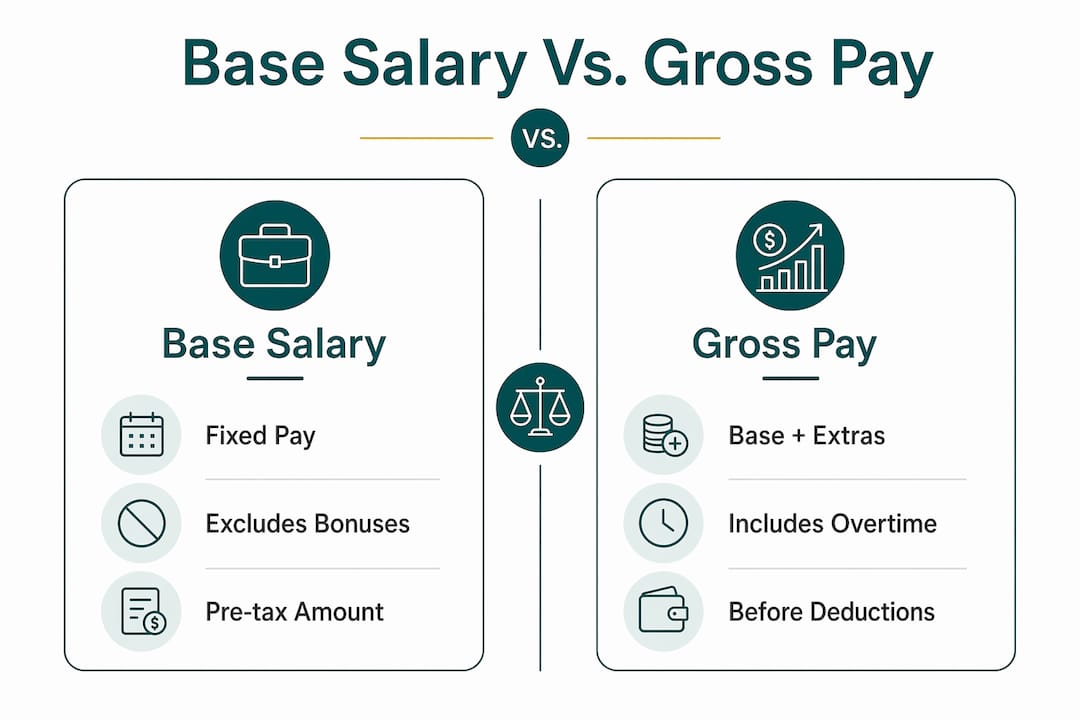
The gap between base salary and total compensation can be significant. A $80,000 base salary at a company with strong health benefits, a 401(k) match, and annual stock grants can represent $110,000 or more in total compensation. Always ask for both numbers when evaluating an offer.
What factors influence base salary determination?
Employers determine base salaries using market data, internal pay bands, job level, and location-based adjustments. Each factor carries real weight, and understanding them helps you know whether an offer is fair.
- Market data and salary benchmarking. Employers survey compensation databases and industry reports to understand what similar roles pay in their sector. Fairpayguide aggregates anonymized salary data across roles and regions to give both employers and job seekers a clear market reference. Learning about salary benchmarking practices helps you understand how your target role is priced.
- Internal pay equity. HR professionals emphasize internal equity to avoid long-term pay disparities. A company sets pay bands for each job level so that two people in the same role earn within a consistent range.
- Location and cost of living. A software engineer in San Francisco earns more in base pay than the same role in Austin, even at the same company. Remote work has complicated this, with some employers applying geographic pay adjustments and others offering location-neutral salaries.
- Industry standards. Finance and technology sectors consistently offer higher base salaries than nonprofit or education sectors for comparable skill sets.
- Company compensation philosophy. Some companies pay at the 75th percentile of the market to attract top talent. Others pay at the median and compete on culture or equity.
Pro Tip: Before your next interview, look up the base salary range for your target role on Fairpayguide’s salary lookup tool. Knowing the market range gives you a specific, defensible number to anchor your negotiation.
Why is base salary important for career and financial planning?
Annual base salary is the central reference point in compensation strategy, used as the baseline for bonuses, retirement contributions, and payroll taxes. This means a higher base does not just increase your paycheck today. It multiplies your financial outcomes over time.
Here is why the base number matters so much beyond the immediate paycheck:
- Retirement contributions. Your 401(k) contribution limit and your employer’s matching contribution are often calculated as a percentage of your base salary. A $5,000 difference in base pay can translate to thousands of dollars in retirement savings over a career.
- Bonuses and raises. Most annual raises and performance bonuses are expressed as a percentage of base salary. Small increments in base salary compound significantly over a career because each subsequent raise builds on a higher starting point.
- Severance packages. If you are ever laid off, severance is typically calculated as weeks of base pay. A higher base means a larger financial cushion during a job transition.
- Pay equity. Base salary affects retirement contributions, severance packages, and annual raises. Organizations that track internal equity use base salary data to identify and correct pay gaps across gender, race, and tenure.
- Cash flow and budgeting. Payroll frequency impacts take-home cash flow. A $72,000 annual base salary pays out as $6,000 per month, $3,000 biweekly, or $1,385 weekly. Knowing how your base divides across pay periods helps you plan rent, loan payments, and savings contributions accurately.
Pro Tip: When comparing two job offers, calculate the long-term value of each base salary by projecting a 3% annual raise over five years. The offer with a higher starting base will almost always pull ahead significantly, even if the lower offer comes with a slightly larger signing bonus.
How to approach base salary in salary negotiations and job evaluations
Negotiating salary is uncomfortable for most people, but a clear process makes it manageable. Candidates should prioritize base salary during negotiations because it is the most stable and guaranteed portion of pay, unlike bonuses or stock options that depend on conditions outside your control.
- Understand the base before evaluating the total package. Ask the recruiter to separate the base salary from bonuses and benefits in writing. This prevents you from overvaluing a package where most of the money is variable.
- Research internal and market benchmarks. Use salary data from Fairpayguide and resources like the U.S. Bureau of Labor Statistics to establish a credible range for your role, level, and location. Arriving with data shifts the conversation from opinion to evidence.
- Account for location and currency in remote or cross-border roles. Currency fluctuations can reduce the practical value of a static base salary for international employees. If you are paid in a foreign currency, factor in exchange rate risk when evaluating the offer.
- Negotiate the base first, then the extras. Once you agree on a base, you can negotiate signing bonuses, equity, or remote work stipends. Reversing this order often leads to accepting a low base in exchange for perks that disappear after year one.
- Avoid anchoring too low. Many candidates name a number first and set the ceiling too low. Let the employer state a range when possible, then negotiate upward from the top of their range using your market research. You can review salary structures across countries to understand how global norms affect what is reasonable to ask.
A common pitfall is accepting a strong total compensation package without scrutinizing the base. Stock options can expire worthless. Bonuses can be cut. The base salary is the one number that shows up every single pay period, no matter what.
Key takeaways
Base salary is the guaranteed fixed pay that anchors your total compensation, drives your retirement savings, and sets the ceiling for every raise and bonus you will ever receive.
| Point | Details |
|---|---|
| Base salary definition | Fixed gross pay agreed before deductions, excluding bonuses, benefits, and variable pay. |
| Base vs. total compensation | Base salary makes up roughly 70% of total compensation. The rest is variable or benefits. |
| Factors that set base pay | Market data, internal pay bands, job level, location, and company pay philosophy all shape the number. |
| Long-term financial impact | Raises, bonuses, and retirement contributions are calculated as a percentage of base, so a higher base compounds over time. |
| Negotiation priority | Always negotiate base salary first. It is the only guaranteed element of your pay. |
Why I always tell people to nail down the base first
People ask me all the time whether they should take a lower base for better equity or a bigger bonus pool. My honest answer is almost always the same: get the base right first, then talk about everything else.
I have seen too many professionals accept roles where the base was $15,000 below market because the recruiter emphasized a generous bonus structure. Two years later, the bonus got cut in a tough quarter, and they were stuck earning below market with no easy way to correct it. That initial base salary decision followed them through every subsequent raise cycle.
The other thing people underestimate is the psychological effect of starting low. When your base is below market, every annual review becomes a catch-up exercise rather than a reward for performance. HR systems often cap raises at a fixed percentage, which means a low starting point can take four or five years to correct through normal raise cycles alone.
My advice: treat the base salary conversation as the most important financial negotiation you will have that year. Come in with real data, know your number, and do not let a flashy total compensation figure distract you from the guaranteed core. The benefits of salary benchmarking for your career are real, and the data is more accessible than most people realize.
— Obinna
Salary data that puts you in control
Knowing what base salary means is only useful if you can act on it. Fairpayguide gives you the real salary data you need to walk into any negotiation with confidence.
Use the Fairpayguide salary lookup to find base salary ranges for your specific role, industry, and location. If you want to contribute to more accurate market data, you can submit your salary anonymously in minutes. Every submission strengthens the data pool for everyone. Fairpayguide also lets you compare salaries across regions and roles worldwide, so you always know where you stand relative to the market before you sign anything.
FAQ
What does base salary mean on a job offer?
Base salary on a job offer is the fixed annual amount the employer guarantees to pay you, before taxes, bonuses, or benefits. It is the most stable part of your compensation.
Is base salary the same as gross pay?
No. Base salary is your fixed annual pay. Gross pay is what you earn in a specific pay period, which can include overtime and bonuses on top of your base.
How is base salary calculated per paycheck?
Divide your annual base salary by the number of pay periods in a year. A $60,000 salary paid biweekly equals $2,307.69 per paycheck before taxes.
Does base salary include taxes?
Base salary is a pre-tax figure. Taxes, Social Security, and Medicare contributions are deducted from your gross pay to produce your net or take-home pay.
Why does base salary matter more than total compensation in negotiations?
Base salary is guaranteed every pay period, while bonuses and stock options depend on performance or company conditions. Candidates should focus on guaranteed base salary first because it sets the baseline for raises, retirement contributions, and severance calculations.